Thread Rating:
  • 0 Vote(s) - 0 Average
  • 1
  • 2
  • 3
  • 4
  • 5

What I am planning & a few doubts
#11

(15-02-2015, 03:03)Brett Wrote:  The Sensiron data sheets all talk about managing heat transfer into the sensor by doing things like the others do (...)
Good point.


(16-02-2015, 11:51)meteoestarreja Wrote:  in Superheterodyne 3400RF, you should always choose a model with those little plate on TX module (...) that little shield, could make the difference.

I noticed that, thanks for the advice. Purchased shielded models (at least according to pics) Smile
Reply
#12

3 weeks down the road 2/3 of eBay stuff from China has arrived. Hong Kong expedited material arrived one week faster.

Combining Adafruit's tutorial with uncle_bob's excellent Fritzing schematics I ventured myself with my first hands on experiment with the DHT22 sensor (pic. below). I skipped the "place a 10K resistor between VCC and the data pin, to act as a medium-strength pull up on the data line" as this does not seem to be needed/ used in WeatherDuino.
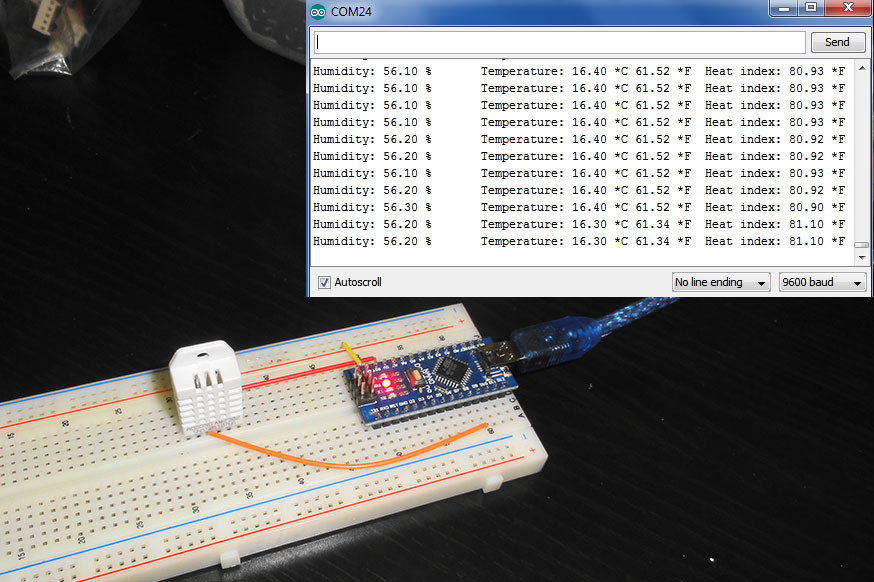
   

uncle_bob, any chance you can kindly put a similar schema for current RX 4.03 board? This is an extremely useful tool to test everything is working fine before any soldering.

After visiting a local shop for parts I now have a couple of doubts/questions:

1 - For test purposes, can we use a polyester 100nf capacitor rated at 250V with a 5% tolerance (instead of the ceramic 50v model). Or does it smell like... burned stuff?

Considering "The voltage rating on a capacitor is the maximum amount of voltage that a capacitor can safely be exposed to and can store" I suppose it can not store more voltage than what it is supplied. Still...

2 - Also for test purposes, since they are more readily available, I suppose there is no problem temporarily using carbon - 5% tolerance - resistors?

Thanks
Reply
#13

(05-03-2015, 21:28)hvalentim Wrote:  1 - For test purposes, can we use a polyester 100nf capacitor rated at 250V with a 5% tolerance (instead of the ceramic 50v model). Or does it smell like... burned stuff?

The biggest difference (I believe) is that polyester ones doesn't do a good job with high frequency signal compared to ceramic one.
About the voltage, you have a 50V rated capacitor, until 50V it does work as supposed no matter if you work with 10 or 40V, higher than 50, it became "out of range" and it can even "explode" (we did that alot just for fun in classes) Big Grin

(05-03-2015, 21:28)hvalentim Wrote:  2 - Also for test purposes, since they are more readily available, I suppose there is no problem temporarily using carbon - 5% tolerance - resistors?
I believe that won't be a problem, but maybe someone around here already tested ...
Reply
#14

(05-03-2015, 21:28)hvalentim Wrote:  I skipped the "place a 10K resistor between VCC and the data pin, to act as a medium-strength pull up on the data line" as this does not seem to be needed/ used in WeatherDuino.

Congratulations for the first test with the Arduino.
I think that 10K resistor MUST be used. At least I never saw any DHTxx connected to a Arduino without the pull up resistor.
In WeatherDuino RX v4.03 board that resistor is R4. Doesn't seem a good idea left the data pin float between reads.

Reply
#15

(12-02-2015, 00:06)hvalentim Wrote:  Looking at it more carefully, I don't thing either the SHT15 or the SHT21 (or the HTU21D, since both have the same chip and board form factors) will fit the plastic cover. Not without some tweaking/cutting.

Answer to myself hopefully of use for future builders: these particular plastic covers may hold any of the temperature/humidity sensors. The limit to bear in mind is not width or length but depth. Meaning, there is not enough space for boards with straight up pins (see attached pictures).

As I suspected, one must use a connection with right angle pins (running parallel to the board).


Reply
#16

Following the TX 2.5 Unit, 9 weeks down the road, I have finally completed my RX Unit. So far so go!

Here's my interpretation of Werk_AG's masterpiece:


I have to yet to finish the cases, a couple of FARS and one more TX :/
Reply
#17

What to say? It's a pro interpretation! Your RX unit, looks far better than mine Cool
Congratulations

Maybe you could add also the pictures of your TX unit to this thread.

PS: You said on another post, that had never done a soldering job before. Hard to believe! SmileSmileSmile Well done

Reply
#18

Very nice job!
What's that 7809 IC?
Reply
#19

(10-04-2015, 10:30)uncle_bob Wrote:  Very nice job!
What's that 7809 IC?

Actually it's the TSR 1-2490 - TRACOPOWER DC/DC CONVERTER I have discussed here.

I have used it just because it costed me good money and I had it around but I would not advise anyone to go that way. Purchasing a good 7809 (from the A series) is likely a safer bet. There's a risk the DC/DC converter may interfere with the TX module nearby, we will see.
Reply
#20

My RX Unit Case.


Updated (16/04/2015): Better quality pic.s and inner cabling.
Reply


Users browsing this thread: 1 Guest(s)