

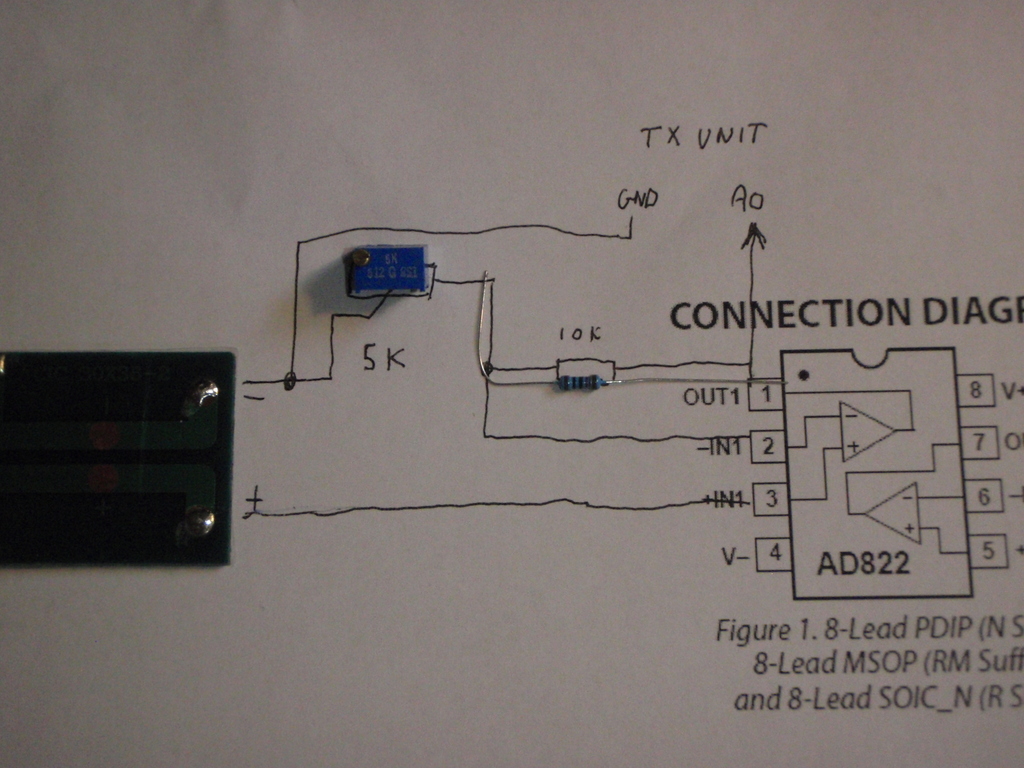
Have I got this correct?
Measuring Solar Radiation based on Photovoltaic Cells
Posts: 799
Threads: 27
Joined: May 2015
Weather Station: WeatherDuino Pro2
Country:
Threads: 27
Joined: May 2015
Weather Station: WeatherDuino Pro2
Country:


Posts: 168
Threads: 0
Joined: Feb 2015
Weather Station: Fine Offset (various)
Country:
Threads: 0
Joined: Feb 2015
Weather Station: Fine Offset (various)
Country:
12-07-2015, 15:19
Hi,
Looks OK, provided that you (have) put the "Short-Circuit Load Resisitor" (typically a few ohms) directly across the PV Panel terminals. And of course connected Power and Ground to the Op-Amp pins.
Cheers, Alan.
Looks OK, provided that you (have) put the "Short-Circuit Load Resisitor" (typically a few ohms) directly across the PV Panel terminals. And of course connected Power and Ground to the Op-Amp pins.
Cheers, Alan.
Posts: 799
Threads: 27
Joined: May 2015
Weather Station: WeatherDuino Pro2
Country:
Threads: 27
Joined: May 2015
Weather Station: WeatherDuino Pro2
Country:
(12-07-2015, 15:19)AllyCat Wrote: Hi,
Looks OK, provided that you (have) put the "Short-Circuit Load Resisitor" (typically a few ohms) directly across the PV Panel terminals. And of course connected Power and Ground to the Op-Amp pins.
Cheers, Alan.
OK thanks; 10 ohm or less for "Short-Circuit Load Resistor"; Pin 4 to TX ground and Pin 8 to TX 5V?

Posts: 5.435
Threads: 337
Joined: Apr 2014
Weather Station: WeatherDuino 4Pro
Country:
Threads: 337
Joined: Apr 2014
Weather Station: WeatherDuino 4Pro
Country:
12-07-2015, 23:31
Of course the value of the "resistor load short-circuit" will depend on the specifications of the photovoltaic cell (as the others too). Personally, with the tested PV cells, I have obtained better results with lower values for the "resistor load short-circuit", resistors between 1 and 1.5 Ohms seems to give the best linearity response.
Personal tests on this matter, are welcome.
Soon we will have a solar module kit available. In those kits, I'm using as Rsh, an 1 Ohm resistor soldered directly to the PV cell. The PV cell used is a 2V, 150mA
Someting like this:
![[Image: Solar_Interface_v310_kit01.jpg]](http://www.meteocercal.info/forum/images/01forum_img/Solar_Interface_v310_kit01.jpg)
Personal tests on this matter, are welcome.
Soon we will have a solar module kit available. In those kits, I'm using as Rsh, an 1 Ohm resistor soldered directly to the PV cell. The PV cell used is a 2V, 150mA
Someting like this:

16-07-2015, 14:19
hello, i'm logging using arduino, and i'm wondering how to convert the values logged into irradiance value (w/m2)? assume w/o amplifier, if my readings are 300, 500 and 600, what value does it represent if i were to follow the examples on step 5? i'm really sorry if i'm unintelligent to understand the steps.

Posts: 380
Threads: 8
Joined: May 2015
Weather Station: Olivier - PHOTOGRAPHIES
Country:
Threads: 8
Joined: May 2015
Weather Station: Olivier - PHOTOGRAPHIES
Country:
(12-07-2015, 23:31)Werk_AG Wrote: Soon we will have a solar module kit available. In those kits, I'm using as Rsh, an 1 Ohm resistor soldered directly to the PV cell. The PV cell used is a 2V, 150mA
Looking forward to it ! and will be happy to test
(16-07-2015, 14:19)seth22 Wrote: hello, i'm logging using arduino, and i'm wondering how to convert the values logged into irradiance value (w/m2)? assume w/o amplifier, if my readings are 300, 500 and 600, what value does it represent if i were to follow the examples on step 5? i'm really sorry if i'm unintelligent to understand the steps.
Hello Seth, why wouldn't you use an amp? As stated by uncle_bob earlier in this post: Possibly, that much has already concluded that, given the reduced amplitude of signals with which we are dealing, they could hardly be read directly by the ADC of an Arduino with an acceptable level of resolution you need it to increase the precision before feeding the arduino.
yea, i know i needed the op amp, but i wish to log 1 set of data without the op amp first then only proceed with op amp, however i do not understand what the logged output represents, and how to convert them into irradiance value. my cf is also rated at 1v 100mA under full sunlight
just found out that op amps cost around 8usd in my country, and i have 11 sensors to-be-amplify, so does that means i need to purchase 6 of them?
just found out that op amps cost around 8usd in my country, and i have 11 sensors to-be-amplify, so does that means i need to purchase 6 of them?
Posts: 168
Threads: 0
Joined: Feb 2015
Weather Station: Fine Offset (various)
Country:
Threads: 0
Joined: Feb 2015
Weather Station: Fine Offset (various)
Country:
18-07-2015, 15:32
Hi,
Unless you put a resistor of about 1 or 2 ohms across the panel (which may produce values up to perhaps 100 or 200) then the results are MEANINGLESS. You must measure the "short-circuit" current from the panel, not an "off load" value. Then you need to calibrate the value against a known light level such as "clear sky sun" at your location.
The circuit doesn't need a particularly "good" Op-Amp, so you should be able to obtain a quantity at a cost of much less than $8 each. You just need to look for a "rail to rail" type (i.e. one that works correctly when the inputs and outputs are at ground potential).
Cheers, Alan.
(18-07-2015, 03:46)seth22 Wrote: rated at 1v 100mA under full sunlight
Unless you put a resistor of about 1 or 2 ohms across the panel (which may produce values up to perhaps 100 or 200) then the results are MEANINGLESS. You must measure the "short-circuit" current from the panel, not an "off load" value. Then you need to calibrate the value against a known light level such as "clear sky sun" at your location.
The circuit doesn't need a particularly "good" Op-Amp, so you should be able to obtain a quantity at a cost of much less than $8 each. You just need to look for a "rail to rail" type (i.e. one that works correctly when the inputs and outputs are at ground potential).
Cheers, Alan.
18-07-2015, 15:40
i'm able to borrow a pyranometer or nip from my friend, so i need to plot the current and w/m2 relationship? now i have not connect resistor across the panel, but im planning to do so. how does the output from the logger corresponds to the current-w/m2 relationship?
Posts: 168
Threads: 0
Joined: Feb 2015
Weather Station: Fine Offset (various)
Country:
Threads: 0
Joined: Feb 2015
Weather Station: Fine Offset (various)
Country:
Hi,
The "short circuit current" (measured across a low-valued resistor) should vary linearly with the watts/m2 illumination. The line should pass through the origin (0 / 0) so in principle you only need to take one calibration reference point against a "known" source. But more points (on a straight line) will confirm whether your hardware is working properly.
Of course it becomes much more complex if you want to achieve "accurate" pyranometric measurements.
Cheers, Alan.
The "short circuit current" (measured across a low-valued resistor) should vary linearly with the watts/m2 illumination. The line should pass through the origin (0 / 0) so in principle you only need to take one calibration reference point against a "known" source. But more points (on a straight line) will confirm whether your hardware is working properly.
Of course it becomes much more complex if you want to achieve "accurate" pyranometric measurements.
Cheers, Alan.
« Next Oldest | Next Newest »
Users browsing this thread: 13 Guest(s)