The Gauge that Mark has bought is a Hydrological Services TB2 Syphoning Tipping Bucket Rain Gauge.
Sighting of rain Gauges is always a problem. Though many government stations that are put up for local monitoring have the gauge off the ground, true scientific gauges are at either 305mm or ground level with an anti splash grid around them. You will see that the gauges at 1000mm above ground have a different (and lower ) quality code for their data than those at 305mm or Ground level. See these attachments. (by the way the anemometer and vane at the CEH are the same as mine see avatar pic) Mark; your Gauge is mentioned in attached doc. Your model (TB2) has been superseded by the TB3. None the less the TB2 was one of the best gauges and many are still employed in sites around the world. Syphoning systems are a way of evening out rainfall events and reducing error in the tipping bucket, adding a syphon makes the
gauge intensity “flatter” at low rainfall rates. I think the TB2 has a diameter of 200mm, if not, you will have to alter the arithmetic below accordingly.
This picture from Wallingford Site (
http://www.ceh.ac.uk/our-science/monitor...al-station )
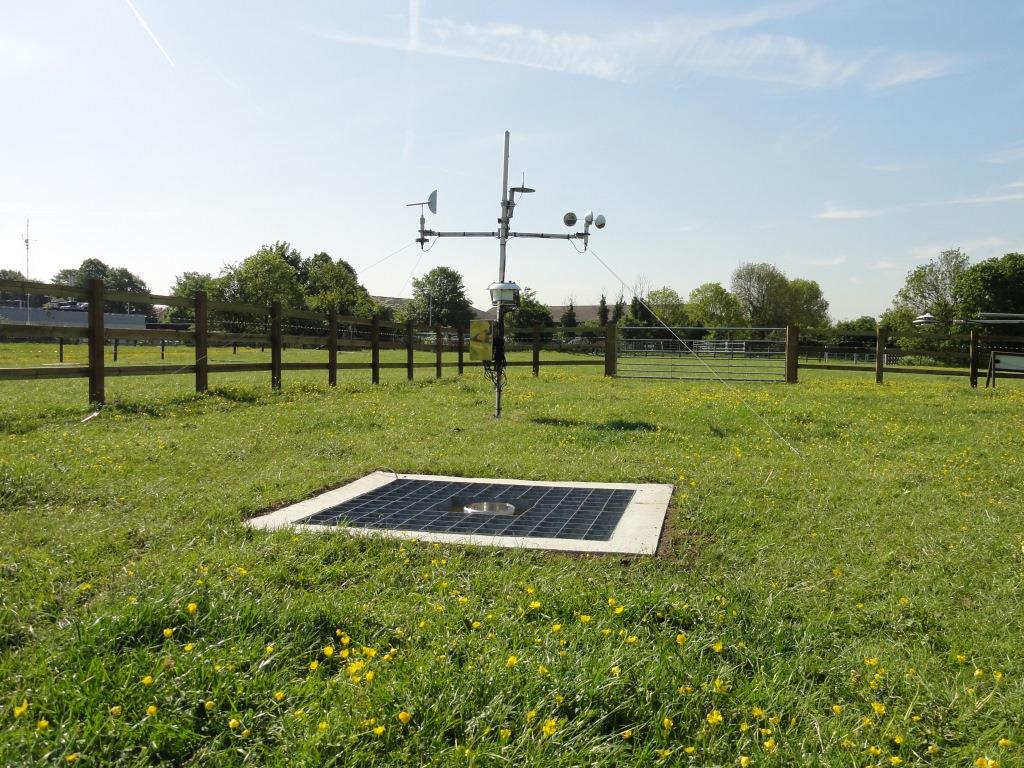
cut and paste from my word document. I cannot find my post it is there somewhere:
Correct way to calibrate and check Rain Gauge:
The tipping-bucket mechanism is a simple and highly reliable device.
The rain gauge must be calibrated with a controlled rate of flow of water through the tipping-bucket mechanism. The maximum rainfall rate that most tipping bucket rain gauges can accurately measure is 25mm of rain per hour (approx. 36 seconds between bucket tips). Therefore, the rain gauge is calibrated using a water flow rate equivalent to, or less than, 25mm of rain per hour (more than 36 seconds between bucket tips). If the flow rate is increased beyond 25mm / hr, a properly calibrated instrument will read low. Decreasing the rate of flow will not materially affect the calibration. The reason for this is obvious. Watch the tipping bucket assembly in operation. With water falling into one side of the tipping bucket, there comes a point when the mass of the water starts to tip the bucket. Some time is required for the bucket to tip (a few milliseconds). During the first 50% of this tipping time water continues to flow into the filled bucket; the last 50% of this tipping time water flows into the empty bucket. The amount of water flowing during the first 50% of time is error, the faster the flow rate the greater the error. At flow rates of 25 mm/hr or less, the water actually drips into the buckets rather than flowing. Under this condition, the bucket tips between drips, and no error water is added to a full moving bucket.
To Calibrate:
NB: Use a vernier caliper accurate to 0.02mm.
1) First work out the cross sectional area of your rain gauge. Measure the internal diameter of your rain gauge receiver if it is round use: A=πr^2. Assume a for arguments sake our rain gauge has a diameter of 200mm.
i) 200 / 2 = 100
ii) 100 x 100 x π = 31428.6 mm2
iii) 314.29 x 2 = 629 ml of water will represent 20mm of rain falling on your gauge.
2) Obtain a plastic or metal container of at least one litre capacity. Make a very small hole (a pinhole) in the bottom of the container.
3) Place the container in the top funnel of the Rain Gauge. The pinhole should be positioned so that the water does not drip directly down the funnel orifice but rather run down the funnel cone.
4) Pour
exactly 629ml ( or the amount you have calculated for your rain gauge) of water into the container. Assume each tip of the bucket represents 0.2 mm of rainfall. Then your gauge should have tipped 100 times. If it has not tipped 100 times after the 629mm of water has passed through then you need to adjust until you get to 629 mm creating 100 tips. Of course one of the advantages of weatherduino is that you can put any figure into your rainfall calibration on the rx config file. However assuming your gauge is 200mm diameter and correctly set you should get this result and be able to put 0.200 into the RX config.
5) If it takes less than one hour for this water to run out, then the hole (from step 1) is too large. Repeat the test with a smaller hole.
(Adjusting screws on Davis and the better quality gauges are located on the base of the Rain Gauge housing underneath the buckets. Turning the screws clockwise increases the number of tips per measured amount of water. Turning the screws counterclockwise decreases the number of tips per measured amount of water. A 1/4 turn on both screws either clockwise or counter-clockwise increases or decreases the number of tips by approximately one tip. Adjust both screws equally; if you turn one a half turn, then turn the other a half turn.)
6) Repeat Steps 3–6 as necessary until the Rain Gauge has been successfully calibrated.
Some interesting numbers; 1mm of rain falling over 1 hectare is 10,000 litres of water or 10 tonnes of water.




![[Image: ldrEfev.jpg]](http://i.imgur.com/ldrEfev.jpg)
![[Image: 9hypEpH.jpg]](http://i.imgur.com/9hypEpH.jpg)
![[Image: HUSc1NW.jpg]](http://i.imgur.com/HUSc1NW.jpg)

