Thread Rating:
  • 1 Vote(s) - 3 Average
  • 1
  • 2
  • 3
  • 4
  • 5

TX Units power
#41

As for the charger controller, those oscillation you refer looks like the controller is always commuting from charging to non-charging and the other way around, at least, the voltage you told - 13 looks like the voltage from battery fully charged and 15 from controller charging voltage (those 15,6 looks like a bit higher than it should).
Anyway, I was able to test fast changing on input voltage and the result is what I expected, the regulator did a nice job maintaining the output voltage constant.
Adding an capacitor will help but the regulator itself should had those variations covered.
Reply
#42

Some progress:

1 - Adding a 100 uF electrolytic capacitor to the input line is enough to insure a steady output.

2 - Seems the freak 2v oscillation had some relation with the fact the battery used was an end of life sulfated unit. With a different battery in better shape the oscillation was reduced to half (around 1v).


(06-03-2015, 22:39)meteoestarreja Wrote:  it looks like the controller is always commuting from charging to non-charging and the other way around (...)
Precisely. This is what I was reading in the display as well.
Charging - Non Charging - Charging - Non Charging
13,6 -15,6 - 13,6 - 15,6

Quote:those 15,6 looks like a bit higher than it should
Yes. It's way too high. But sulfated batteries do have weird behaviors. The battery response might have been confusing the regulator.

Anyway with a different battery things seem to have improved.
Reply
#43

It seems difficult to convince you that even with a fast change in the input voltage the output voltage of the regulator must remain constant.
Probably your 7809 regulator is damaged, if I remember, at some point you had connected the 7809 with a load, but without connecting the GND pin. This certainly damaged the regulator.

Reply
#44

(06-03-2015, 19:39)Werk_AG Wrote:  I'm using one of those cheap chinese solar regulators, for more than two years, and my TX unit with a 7809 is happily working with it.

I do not doubt either your judgment of experience. I am sure they might do a reasonable job under moderate use.

I am just saying I have seen similar models fry easily and I would not trust them for more demanding use/loads, say powering a home. Also chinese unbranded photo-voltaic material in general, like inverters, tend to be extremely inefficient.

(07-03-2015, 16:07)Werk_AG Wrote:  if I remember, at some point you had connected the 7809 with a load, but without connecting the GND pin. This certainly damaged the regulator.
True. But I did purchase a couple and the second behaves similarly. Still, it does look like it had a sink applied before. Perhaps it's not new.

Anyway, I will scrap both have experiment with more. No worries.
Reply
#45

(07-03-2015, 16:07)hvalentim Wrote:  I do not doubt either your judgment of experience. I am sure they might do a reasonable job under moderate use.

I am just saying I have seen similar models fry easily and I would not trust them for more demanding use/loads, say powering a home. ...

And powering a TX unit is very moderate use. We are not discussing here, ways to solar powering a home.

We are losing the focus! If an 7809 doesn't work for you, try with a DC / DC converter.

Reply
#46

(07-03-2015, 16:35)Werk_AG Wrote:  And powering a TX unit is very moderate use.
No doubt.

Quote: We are not discussing here, ways to solar powering a home.
No. But in the future I may wish to use the part in a different way.

Quote:We are losing the focus! If an 7809 doesn't work for you, try with a DC / DC converter.
With or without part defect and or assembly error involved it is working for me right now and I am happy with it.
Reply
#47

Following this discussion, I compared the output of three 9v regulators under particular conditions of systematically fluctuating input voltage.

Models used were:

TSR 1-2490 - TRACOPOWER DC/DC CONVERTER, 9V, 1A, STEP DOWN:
http://assets.tracopower.com/TSR1/docume...asheet.pdf
L7809CV - STMICROELECTRONICS IC, V REG +9.0V, 7809, TO-220-3, 1.5A:
http://www.farnell.com/datasheets/1805459.pdf
LM7809ACT - FAIRCHILD SEMICONDUCTOR LINEAR VOLT REG, 1A, 9V, TO220AB-3:
http://www.farnell.com/datasheets/1855686.pdf

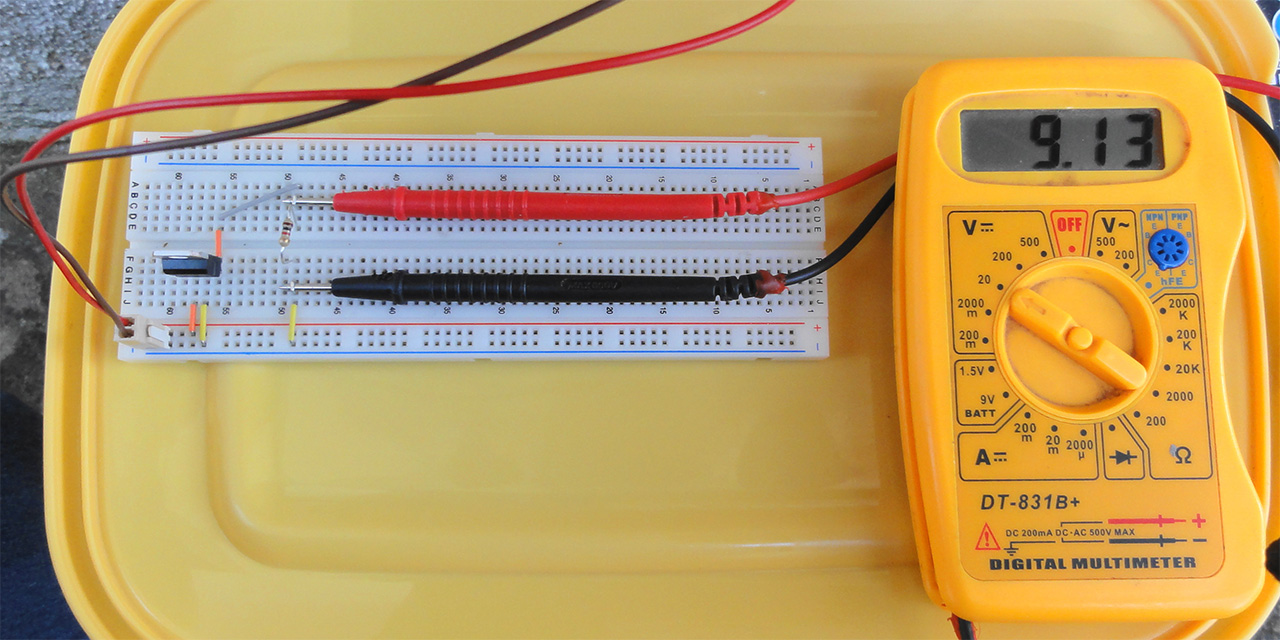
These were brad new units, connected to the 12v output of a Isofoton Isolder 20 D (v.2, old model) solar regulator. The regulator does not seem to regulate battery charge voltage and the 12v output for appliance use separately. Hence the voltage fluctuation, particularly with high irradiation.

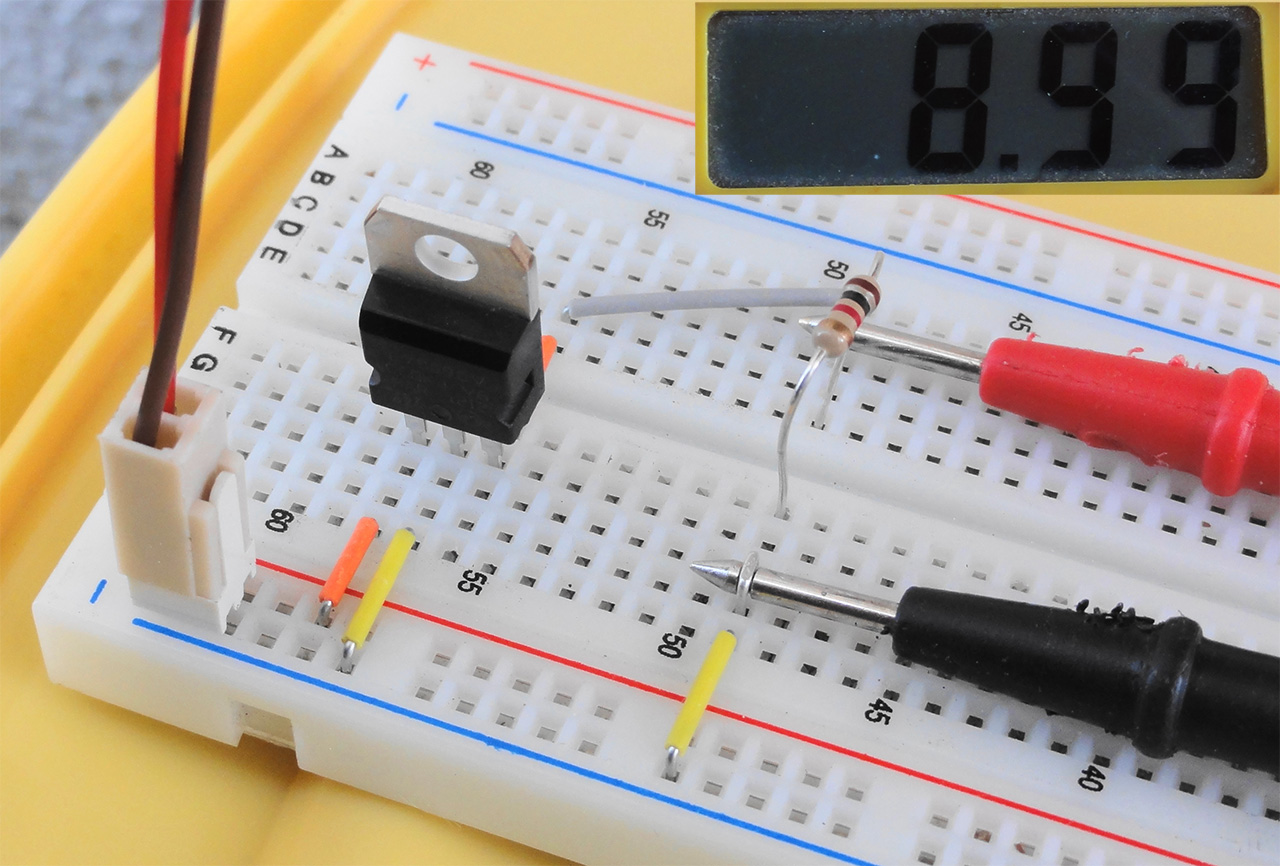
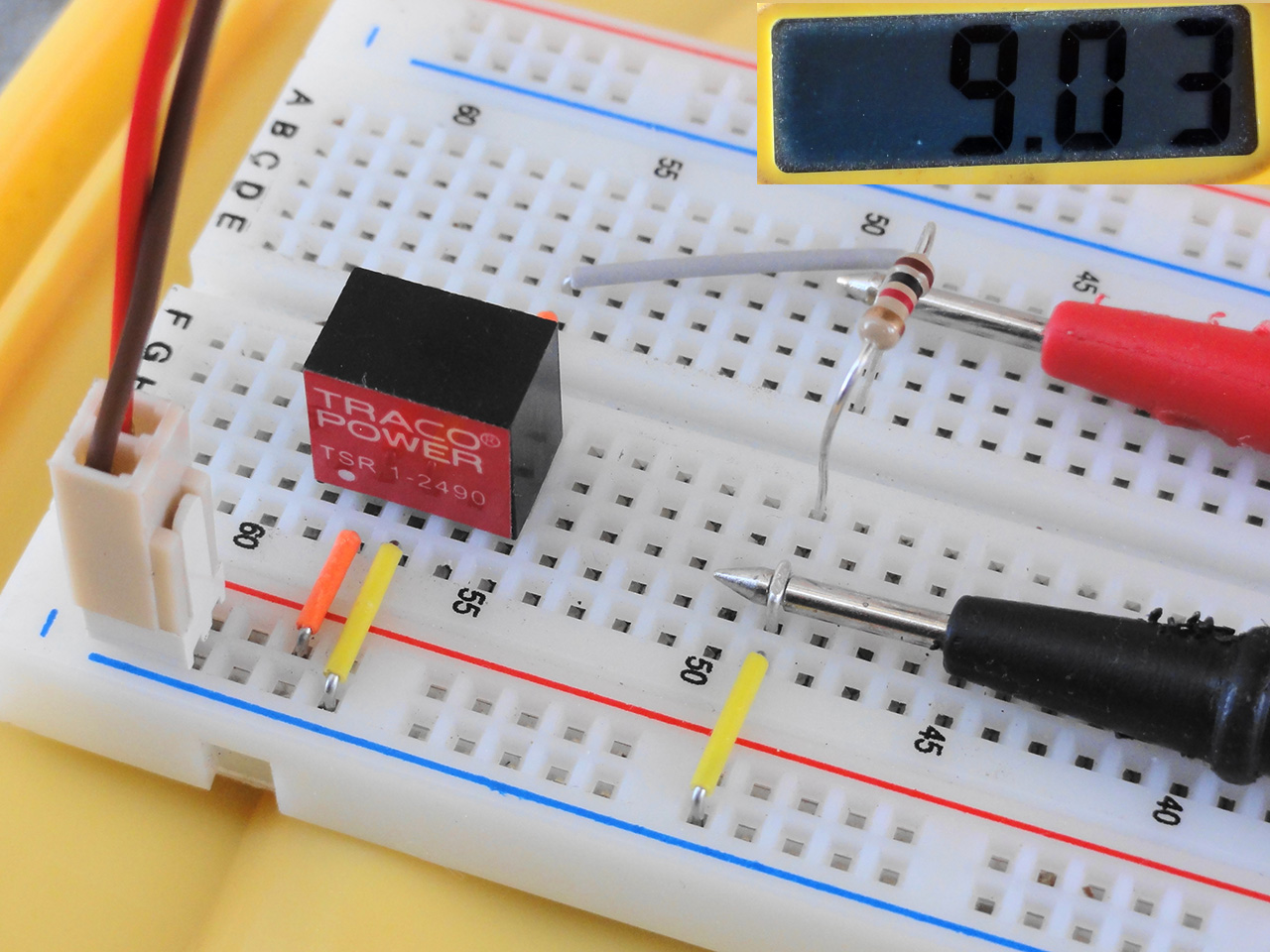
A 1 KOhm resistor was used to provide a dummy load. Ambient temperature was around 18º (see pictures with test assembly below).

A DT-831+ digital multimeter was used to measure the output voltage.

RESULTS Observed

All three regulators provided a stable output voltage regardless of the fluctuating input (steadfastly ranging from 13,8 to 14,9v - see video of conditions below).

Out voltages measured were:
  • TSR 1-2490 -> 9.03v
  • L7809CV -> 9.13v
  • LM7809ACT -> 8.99v
CONCLUSIONS, assuming the multimeter is to be trusted:
  • the best performer in terms of voltage accuracy seems to be the LM7809ACT.
  • the additional 0,5A provided by the L7809CV come with a cost accuracy wise.
  • the TSR 1-2490 DC/DC converter seems to provide an accurate output as well with the advantage of not heating and likely being more efficient/wasting less energy while converting but it costs ~7 times more than the LM7809ACT and it may eventually produce some noise.

Video with input voltage condition while testing the regulators:
http://youtu.be/A3FSooBZYzY

L7809CV & general assembly:
   
LM7809ACT detail:
   
TSR 1-2490 detail:
   
Reply
#48

hvalentim, now that you already have your TX v2.50 board fully assembled, maybe you could check by yourself the real current consumption of the unit (without the fan, of course). I think it will be a good surprise to you, certainly no more than 55 mA to 60 mA peak, and an average of 40 to 45 mA, something far from the values we had talked previously (I pointed to around 100mA, counting with the consumption of the solar controler itself).

Reply
#49

(05-04-2015, 23:03)Werk_AG Wrote:  hvalentim, now that you already have your TX v2.50 board fully assembled, maybe you could check by yourself the real current consumption of the unit

Without the fan and with just one sensor connected (DHT22 temp/hum) I am observing something like:

Board/Nano alone with wireless module -> ~20 mA
Additional max. consumption when reading from DHT22 -> ~8mA
TX Led on draw (20 mA led with 510R applied) -> ~13mA
13+8+20=42mA (a peak of 41,4 was observed)

It is not easy to give an average consumption value just by looking at ever shifting values but I would guess something around 30mA (perhaps a bit less) with this basic setting (not taking into account the solar controller, additional sensors, the Fan Led and the Fan itself, should they be used).
Reply
#50

I can confirm that the more promising one is only PWM too.

(07-02-2015, 13:53)hvalentim Wrote:  
(06-02-2015, 22:45)Brett Wrote:  The controllers I have opted for now are similarly priced (I think). I've been buying the 5A model - on ebay the item number is 261392830593, http://www.ebay.com.au/itm/261392830593?...1439.l2649

According to this fellow that may not be a true MPPT charge controller:
CMTP02 – disassembling this solar charge controller

This one would seem a bit more promissing: Solar Panel Battery Regulator LCD 10A 12V/24V MPPT Charge Controller Three-time

Product Homepage
Manual here

But the peculiar way they use to describe it makes me think it may almost certainly be just a PWM with a twist. They do not seem to provide maximum accepted voltage as well which is odd.

MPPTs work by tracking the I-V curve of panels and picking at any given moment the best volts/amps compromise.

Chaos Manor Weather
Mount Evelyn, Australia
http://www.sdsnet.net/weather/cumulus/indexframe.htm

LaCrosse WS-2300, until I have a Weatherduino Pro2 running.
Reply


Users browsing this thread: 1 Guest(s)